Why systems fail to scale
The real bottleneck is rarely traffic. Systems stop scaling when change becomes entangled.
 Massimiliano RegisSystem Architect · Author · Inventor
Start a conversation ↗
Massimiliano RegisSystem Architect · Author · Inventor
Start a conversation ↗
Thinking
I write about distributed systems from the perspective of decisions, trade-offs, people and long-term consequences — and fiction when the system I want to understand is reality itself.
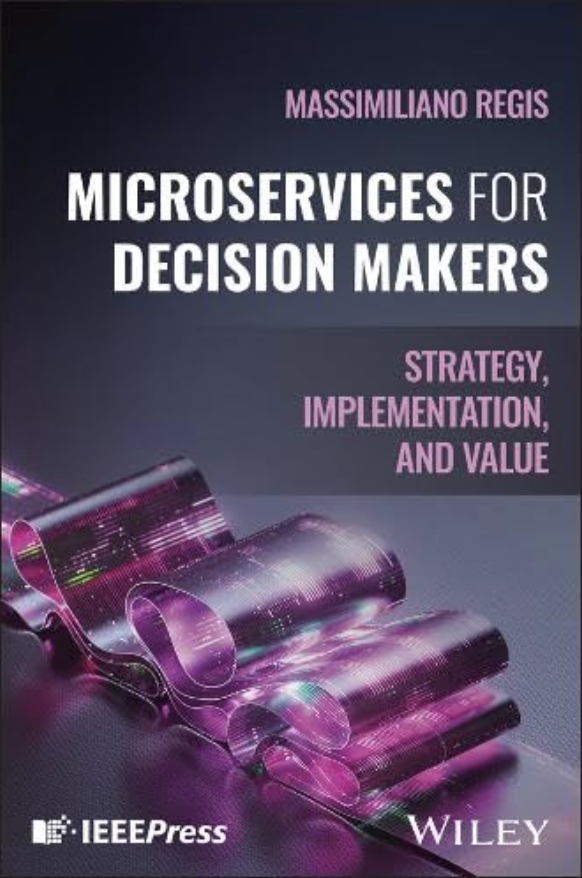
Book · Wiley-IEEE Press · pre-order listings live
A decision-maker’s view of why distributed architectures emerge, when they help, what they cost, and how they reshape governance, teams and risk.
The central idea is simple: microservices do not eliminate complexity. They redistribute it. The important question is whether your organization is prepared to govern where that complexity moves.
Book details & pre-order →A recurring idea
“When an organization chooses an architecture, it is deciding how to distribute complexity, autonomy and risk over time.”
Essays
Short arguments that connect engineering decisions to the way teams and businesses actually behave.
The real bottleneck is rarely traffic. Systems stop scaling when change becomes entangled.
Architecture mirrors communication, decision rights and team boundaries whether we plan for it or not.
Containers and APIs are implementation details. The deeper choice is where responsibility and risk will live.
Literary work
A novel about free will, determinism, biology and the possibility that mathematics is not merely a way to describe reality, but the structure beneath it.
The story moves between science, friendship, memory and recurring patterns — using narrative to ask a systems question at human scale: if everything follows a structure, where does freedom begin?

Thinking in public